Petroleum Levy in Pakistan: Why Rs80 of Every Petrol Litre Goes to the Government Every time you fill your tank in Pakistan, a fixed Rs80 per litre leaves your pocket and goes straight into the federal government’s account. That charge is the petroleum levy, and understanding the petroleum levy Pakistan motorists pay is the key…
Petroleum Levy in Pakistan: Why Rs80 of Every Petrol Litre Goes to the Government
Every time you fill your tank in Pakistan, a fixed Rs80 per litre leaves your pocket and goes straight into the federal government’s account. That charge is the petroleum levy, and understanding the petroleum levy Pakistan motorists pay is the key to understanding why petrol stays expensive even when global oil prices fall.
As of 15 October 2026, petrol costs Rs393.86 per litre. Of that, Rs80 is the petroleum levy alone — and the levy has been at the centre of a national political storm, with opposition parties demanding its abolition and the government admitting it cannot cut it without the IMF’s consent. Here is the full story: what the levy is, how much of your litre it eats, how it got to Rs80, and why it is so hard to remove.
What the Petroleum Levy in Pakistan Actually Is
The petroleum levy (PL) is a federal charge applied per litre on petroleum products. Unlike sales tax, which is collected through the FBR’s tax machinery, the levy is collected at the fuel-pricing stage and its revenue flows directly to the federal government — not the provinces.
The Petroleum Minister has stated publicly that the levy is classified as non-tax revenue, which means it does not require a parliamentary vote to impose or change (press-reported, en.dailypakistan.com.pk, 12 Oct 2026). That classification is precisely what has triggered the current political controversy: the National Assembly’s Standing Committee on Petroleum has debated whether the levy should be put to a vote in the National Assembly, given the lack of legislative approval (press-reported, brecorder.com, ~9 Oct 2026).
It is also important to know that the levy is set by the federal government, not OGRA. OGRA computes daily ex-depot prices from international averages, but the petroleum levy rate is a government policy decision — so it does not automatically move up or down with world oil prices (press-reported, pakera.pk, 7 & 9 Oct 2026).
How Much of Each Petrol Litre Goes to the Government
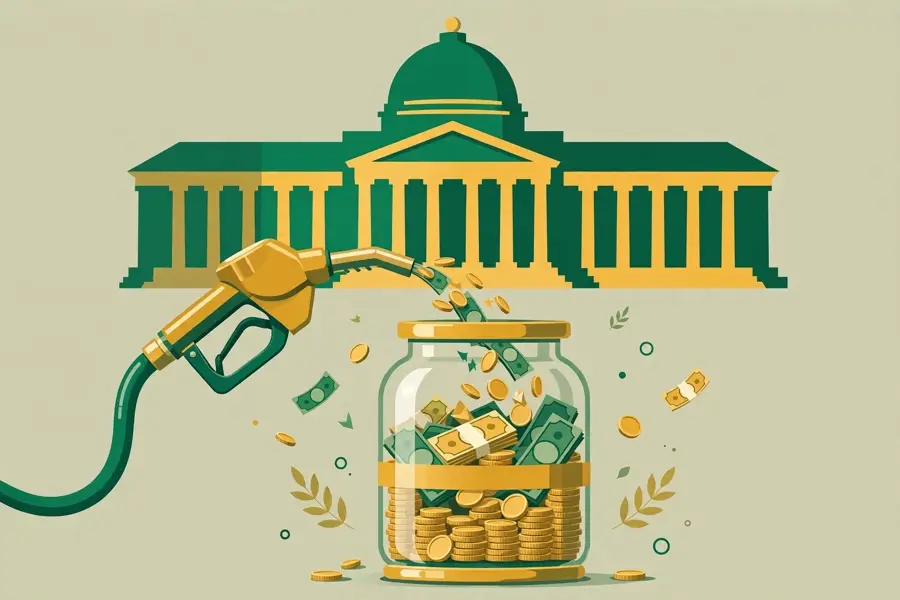
The official price buildup published in the Business Recorder e-paper (13 Oct 2026) shows the following government charges on every litre of petrol:
| Charge on each petrol litre | Amount (Rs) |
|---|---|
| Petroleum levy | 80.00 |
| Climate Support Levy | 5.00 |
| Customs duty | 24.94 |
| Total levies + customs | 109.94 |
Daily price trackers report that levies and customs add approximately Rs109.94 to each litre of petrol (press-reported, pakera.pk, 7 & 9 Oct 2026).
Put that against the pump price of Rs393.86 per litre (effective 15 Oct 2026), and the numbers tell a clear story:
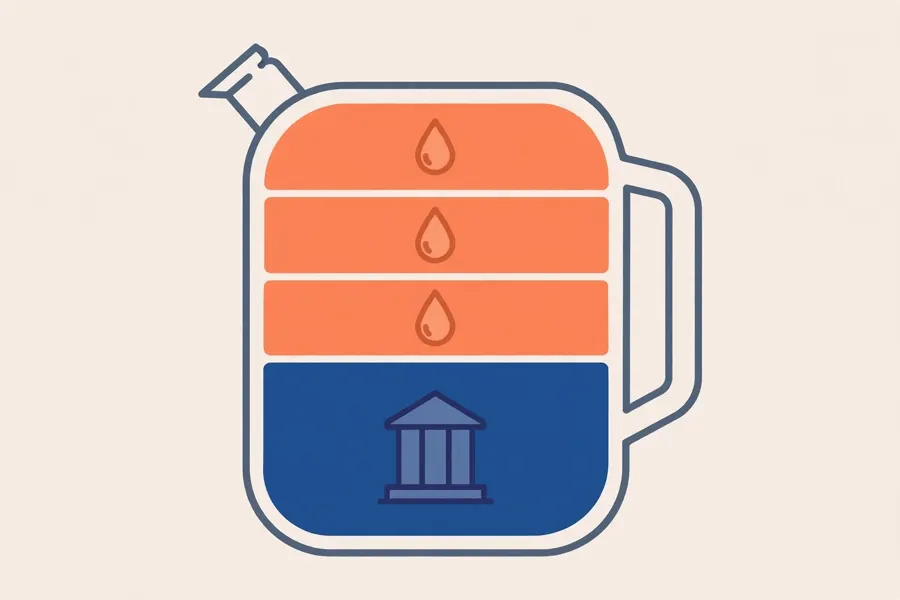
- Petroleum levy + climate levy = Rs85, which is about 21.6% of the pump price (arithmetic: 85 ÷ 393.86).
- All government charges together = ~Rs110, or roughly 28% of what you pay per litre.
So when you buy a litre of petrol, more than one rupee in every five goes to the government as the petroleum levy and climate levy alone — before you even count customs duty.
Petroleum Levy Pakistan: The Road From Rs60 to Rs80
The levy has not always been Rs80. Its climb over the past two years explains much of the anger at the pump:
| Period | Petroleum levy per litre |
|---|---|
| Until 15 March 2025 | Rs60 |
| Mid-2025 | Rs70 |
| April 2025 | Rs78.02 |
| January 2026 | Rs84.27 |
| March 2026 | Rs105.37 |
| 2 April 2026 | Rs160.61 — reversed within 24 hours |
| After reversal | Rs80 (current) |
(Levy timeline press-reported via techjuice.pk.)
The brief Rs160.61 spike on 2 April 2026 — withdrawn within a day — remains the most dramatic moment in the levy’s history. The overall picture is bleak for motorists: petrol has risen by Rs145.13 since the start of 2026, from Rs253 per litre to Rs398.30 on 10 October (press-reported, en.dailypakistan.com.pk, 12 Oct 2026). The 15 October notification brought the price down slightly to Rs393.86 per litre, but the Rs80 levy stayed untouched.
Petroleum Levy Pakistan: Why the Government Can’t Cut It Without the IMF
If the levy is so unpopular, why not reduce it? The answer is fiscal — and international.
1. It is a Rs1.676 trillion revenue line. For fiscal year 2026–27, the government has set a petroleum levy collection target of Rs1.676 trillion, calculated at Rs80 per litre on petrol and diesel — up Rs109 billion from the Rs1.567 trillion collected in FY26 (press-reported, Profit by Pakistan Today, 9 Oct 2026). Removing or cutting the levy would blow a hole of roughly that size in the budget.
2. The minister says the IMF must be consulted. The Petroleum Minister has stated that the government “could not revise its levy collection target without consulting multilateral partners” — a clear reference to the IMF (press-reported, en.dailypakistan.com.pk, 12 Oct 2026). IMF technical talks in Islamabad have reportedly focused on the petroleum levy itself (press-reported, Profit, 9 Oct 2026). In short: cutting the levy needs the IMF’s nod, because the levy is baked into the fiscal commitments Pakistan made under its loan programme.
3. No parliamentary vote is required — but parliament wants one. Because the levy is non-tax revenue, the executive can set and change it without a National Assembly vote. That is exactly what the NA Standing Committee on Petroleum objected to, debating whether the levy should be brought before the House (press-reported, brecorder.com, ~9 Oct 2026).
4. Political pressure is mounting. Jamaat-e-Islami’s emir Hafiz Naeemur Rehman has threatened a long march demanding the complete abolition of the petroleum levy (press-reported, Profit, 9 Oct 2026). Abolition would mean erasing the entire Rs1.676 trillion target — something the government says is impossible without the IMF’s agreement.
What the Levy Means for Your Fuel Bill
Since daily fuel pricing began on 17 July 2026, pump prices move almost every day — currently petrol Rs393.86/L and diesel Rs396.65/L (effective 15 Oct 2026). The levy, however, does not move with them. It sits at Rs80 regardless of whether world oil prices rise or fall, which is a big part of why petrol price cuts feel so small.
If the levy and high prices are squeezing your budget, relief options exist:
- Check today’s petrol price and PSO petrol prices to plan your fill-ups.
- The PM Fuel Relief Scheme 2026 gives registered bike, rickshaw and small-car owners a Rs100 per litre subsidy via the 9771 SMS system — see the 9771 token guide for how to register.
- Read our overview of every fuel relief scheme in Pakistan to see which one applies to you.
- Wondering why pump prices differ from OGRA’s announced price? The answer is connected to these same fixed charges.
Frequently Asked Questions
What is the petroleum levy in Pakistan?
The petroleum levy is a federal charge of Rs80 per litre on petrol (as of October 2026), collected at the fuel-pricing stage. Its revenue goes directly to the federal government and is classified as non-tax revenue.
How much is the petroleum levy per litre right now?
Rs80 per litre on petrol. On top of it sits a Rs5 Climate Support Levy, so the two together add Rs85 to every litre — about 21.6% of the current Rs393.86 pump price (arithmetic).
Is the petroleum levy a tax?
Not technically. The Petroleum Minister has stated it is non-tax revenue, which is why it can be imposed and changed without a parliamentary vote (press-reported, en.dailypakistan.com.pk, 12 Oct 2026). Critics argue this classification lets the government bypass the National Assembly.
Who sets the petroleum levy — OGRA or the government?
The federal government sets the levy. OGRA computes daily ex-depot prices from international market averages, but the Rs80 levy is a government policy decision and does not change with world oil prices (press-reported, pakera.pk, 7 & 9 Oct 2026).
Why can’t the government reduce the petroleum levy?
Three reasons: the FY2026–27 budget targets Rs1.676 trillion in levy revenue at Rs80/L (press-reported, Profit, 9 Oct 2026); the minister says the target cannot be revised without consulting multilateral partners/the IMF; and IMF technical talks have specifically focused on the levy (press-reported, en.dailypakistan.com.pk, 12 Oct 2026; Profit, 9 Oct 2026).
Will the petroleum levy be abolished?
There is political pressure — Jamaat-e-Islami has threatened a long march demanding complete abolition, and the NA Standing Committee on Petroleum has debated putting the levy to a National Assembly vote (press-reported, Profit and brecorder.com, 9 Oct 2026). But abolition would erase a Rs1.676 trillion revenue target, and the government says it cannot move without the IMF’s consent. No abolition decision has been made.
